Psychological Service
Psychological Tests
Psychological Method "My Class"
Psychological Method "My Class"
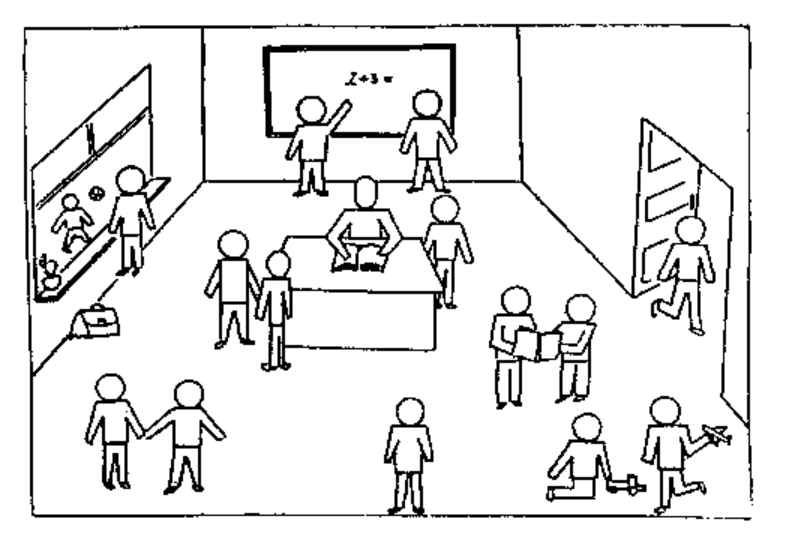
Younger schoolchildren have some difficulty working with the scales, questionnaires and tests that study a child's position in a group and are traditionally used in social and psychological practice. In such cases it is more convenient to use this method.
The students are given a sheet with a picture of a classroom. Instruction: "This picture shows your class in a simple scheme. The teacher is sitting at the table, and the students are busy with their own activities. Some of the children are playing. Find yourself in the picture and mark yourself with a cross, then write your first name and surname next to it. Then mark your friend in the picture (also with a cross) and write his or her first name and surname next to it."
It is important for the psychologist to know:
Which of the people in the situation does the participant identify with?
What place in the class does the participant assign to the figure they identify with (next to the teacher, outside the classroom, together with the other children, alone)?
What activities are emotionally significant for the schoolchild?
Analysis of the results:
The picture shows positions that indicate how strong the child's cognitive interests are: solving a task at the board, reading a book together, asking the teacher questions. In this case, identification with such a position indicates that the younger schoolchild's social, psychological and learning status is adequate.
The position "alone, far from the teacher" is an emotionally unfavourable position for a child and points to difficulties in adapting to the class group.
Identifying with children who stand in pairs or play together is evidence of a favourable social and psychological position of the child.
A place next to the teacher: the teacher is a significant person for the participant, and the participant identifies with a student who is accepted by the teacher.
PROJECTIVE TEST FOR CHILDREN
"MY LIFE AT SCHOOL"
If the child attends kindergarten, then in the older groups the child will already be able to understand the moods of these little figures and join you in a game. Here you can change the questions: Which little figure helps everyone? Which little figure hurts everyone? ... Children often start calling the little figures by name. Then it becomes clear to you what the child lives by.
Look carefully at these cheerful little figures.
1. Which little figure do you usually look like? (Put the number 1 on it, and on the others put the number of the question you are answering; one little figure can have 2 numbers from different questions.)
2. Which little figure do you look like today?
3. Which little figure or figures do your friends look like?
4. Are there any little figures here that look like your teachers?
5. Which little figure would you like to approach?
6. Which little figure would you be afraid of?
7. Which little figure looks like the one who let you down?
8. Which one can understand you and help you?
9. Which little figure do you feel sorry for?
10. Which little figure bosses everyone around?
11. Would you like to draw your own little figure here? You can do it.
These questions can be expanded and applied not only to relationships at school but also to the family.
Letter (a method for primary school students)
Dear children and animals! Please tell us about your school life, your friends and your teachers. We would like to find out as much as possible about you. Please answer our questions. To make it easier for you, we have prepared special answer sheets (the psychologist shows the form). For each question there is its own box, and its number matches the number of our question (the psychologist shows it).
Next, the psychologist reads the text of the method aloud, slowly and clearly, making sure that the students draw their answers in the right boxes.
1. Some students like school, and some do not want to go to school because they do not like it there. Do you like school or not? If yes, draw a little sun in the first box (show where exactly); if not, draw a little cloud.
2. What do you like more at school – studying or playing with toys and running with friends? If you like studying, write the first three letters of the alphabet; if you like playing, draw any toy.
3. When a person smiles often, they are like the sun, and when they smile rarely, they are like a cloud. Is your teacher like the sun or like a cloud? If like the sun, draw a sun; if like a cloud, draw a cloud.
4. The fairy in fairy tales is kind and gentle, and she brings warmth and love. The Snow Queen is beautiful but stern. When you come near her, you feel a chill. Is your teacher a Fairy or the Snow Queen? If a Fairy, draw a flower; if the Snow Queen, draw a snowflake.
5. Many people have a secret that cannot be told to just anyone. It can only be entrusted to someone who will listen carefully, will not laugh and will not tell anyone else. Do you think your teacher is such a person and can be trusted with a secret? If yes, draw a flower; if not, draw a cloud.
6. When a person feels bad, they suffer. They become sad and lonely, like Fluffy. When someone upsets you or something does not work out for you, do the other children come to help you? Do they defend you and sympathise with you? Or perhaps nobody in the class helps, and that makes you want to cry? If they help you, draw a flower; if not, draw a fir tree.
7. Imagine that you have a magic wand that can make your wish come true. Would you like to wave it and find yourself in another class where the children are better and kinder? Or are you happy in this class and do not want to be in another one? If you like your class, draw a flower; if you feel bad here, draw a fir tree.
8. At the end of every letter, people write their name. I suggest that each of you draw your own portrait that shows the mood you most often have at school.